

It’s not difficult to see why underfloor heating is becoming a more and more popular method of house heating. It delivers cozy heat, conserves space, and guarantees that warm flooring materials like stone and tiles are underfoot.
Underfloor heating is an excellent companion to a heat pump. Installing them together in a new house or while you’re starting significant renovations might be wise.
However, it’s critical to understand if installing in floor heating in your house is a viable choice for your particular property if you’re thinking about doing so. You may also be curious about its compatibility with other heating methods. And the expense of underfloor heating will undoubtedly be on your list of inquiries.
How Is Underfloor Heating Implemented?
Homeowners may select the two available varieties between electric underfloor heating and water underfloor heating. Water underfloor heating is sometimes called wet underfloor heating, while electric underfloor heating is called dry underfloor heating.
Underfloor Electric Heating
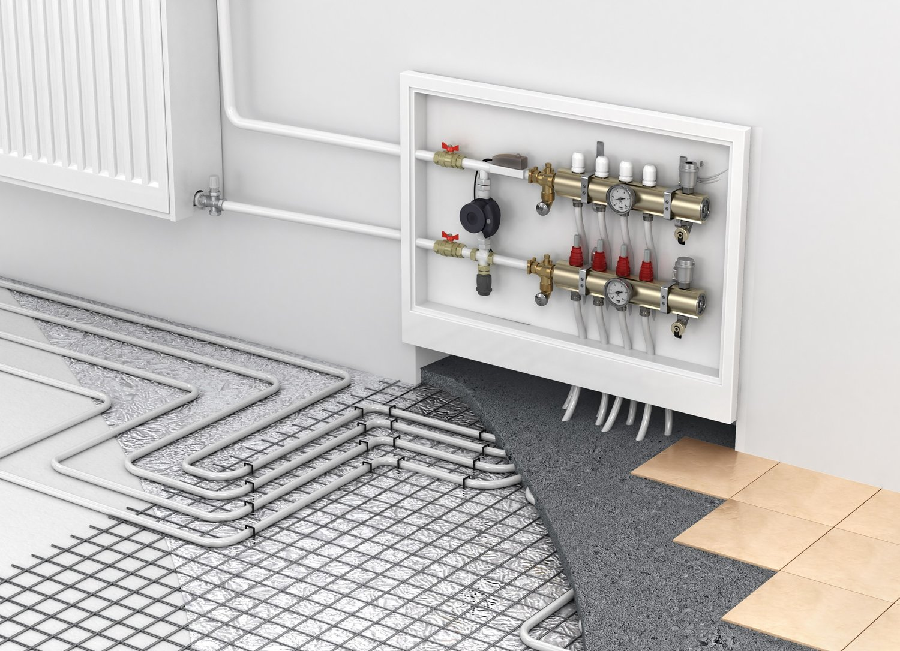
Installing a network of electric wires above the floor insulation and under the floor, the surface is how electric underfloor heating works. Electric underfloor heating spreads heat uniformly using mains power and is often offered as a mat of wires that is simple to lay out. A mat system is utilized to guarantee that there are no cold spots, as shown in the illustration.
Underfloor Water Heating
Like electric underfloor heating, water underfloor heating uses a manifold and water pipes linked to the boiler. Pipework is installed and connected by a plumber above the floor insulation. In these situations, it’s essential to consider the value of moisture-resistant insulation or pipe insulation to preserve and improve the effectiveness of the insulation and the system as a whole.
The Value of Underfloor Heating
People often wonder if underfloor heating is worthwhile since it adds to the cost of a property that already has radiators or another kind of heating. Since underfloor heating is a luxury item, its value cannot just be determined by the installation and purchase price. For some homeowners, the ease of just needing to remove radiators from a few tiny, challenging-to-design rooms makes underfloor heating worthwhile. It is helpful in a design-conscious house were taking out a radiator can allow for a bath rather than simply a shower.
Based on typical household expenses, electric underfloor heating might be cost-effective if you need to heat one or two modest rooms. Water underfloor heating is an excellent option if you’re searching for a plan for your complete house or a big room like a kitchen diner.
Where Should Underfloor Heating Be Used?
Although there are devices to suit additional rooms in the house, including upstairs, underfloor heating is typically utilized in rooms on the ground level.
Wet systems are installed where it is feasible to take up flooring or where new floors are being built. It will thus probably go well with new conservatories, additions, and open-concept cooking spaces.
The electrical mesh system is flatter than a wet system; thus, there is less need to modify floor heights to fit it, making the electric underfloor more likely to be acceptable for existing rooms.
Even electrical mat solutions below rugs on already-installed hard floors are available. Overall, it’s simpler to install electric systems in rooms on higher floors.
Considerations For Flooring:
Carpet
Practically every form of flooring, including carpet, is compatible with UFH. (As long as the carpet and underlay have a heat resistance of under 2.5 togs)
The heat resistance seems less than one tog for most carpet types.
Terracotta, Slate, Stone, And Ceramic
The number of houses with UFH below them has increased as these specific flooring materials gain popularity. The thickness affects how long things take to heat up.
Although thick flagstones take longer to achieve their maximum temperature, there is no variation in the quality of the heat once it has been obtained.
Timber
Many different kinds of wood flooring may be used with UFH, although most installers agree that only certain types of timber should be suggested for UFH usage. The highest temperature limit for the flooring should be 27°C, and an expansion space has to be allowed around the borders (you can easily hide this with a skirting board or trim).
Laminates And Vinyls
UFH may be applied to laminates and high-quality vinyl. Before committing, verifying with the flooring manufacturer or the heating installer is a good idea since not all laminates or vinyl are suitable with UFH.
Conclusion
Everyone is not a fan of underfloor heating. Underfloor heating is not something you should think about if you want hot, dry air that makes your house stuffy. Underfloor heating, however, is unquestionably worthwhile if you desire a consistent ambient temperature and a warm floor under your feet.
