

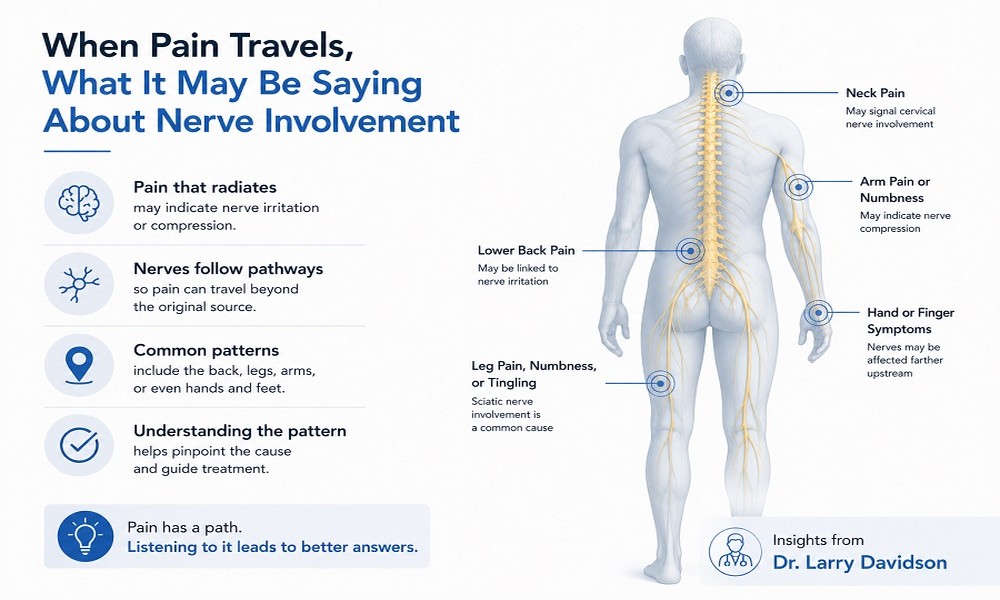
Pain is not always defined by how intense it feels, but by how it behaves. A sore muscle tends to stay in one place, responding to movement or rest in predictable ways. When pain begins to travel, following a distinct path through the body, it often raises a different set of questions. This pattern is commonly associated with the nervous system rather than the muscles alone. Dr. Larry Davidson, a board-certified neurosurgeon with fellowship training in complex spinal surgery, has seen how patients often describe this shift clearly, noting that the discomfort no longer feels localized but instead moves in a way that is harder to ignore or explain.
Recognizing this distinction is important because radiating pain often reflects how spinal structures interact with nearby nerves. Rather than being a variation of typical back or neck pain, it can indicate that signals are being altered along specific pathways, which may require a different approach to evaluation and treatment.
What Makes Radiating Pain Different
Radiating pain tends to follow a consistent route rather than appearing randomly. Patients often describe it as sharp, burning, or electric, and it may extend from the spine into the arms or legs, depending on where the issue originates. This pattern reflects the distribution of a specific nerve rather than a generalized area of discomfort.
In the lower back, radiating pain may travel through the buttocks and down the leg, sometimes reaching the foot. In the cervical spine, it may extend into the shoulder, arm or hand. What distinguishes this type of pain is not just its intensity, but its direction and repeatability. Each time it occurs, it often follows the same pathway.
How Nerves Become Involved
The spine serves as both a structural support system and a protective channel for the nervous system. Nerve roots branch out from the spinal cord and carry signals that control movement and sensation throughout the body. When these nerves are compressed or irritated, those signals can change, leading to symptoms that extend beyond the spine itself.
One of the most common causes of this type of involvement is a herniated disc. When the inner portion of a disc pushes outward, it can press against a nearby nerve root. This pressure can disrupt normal signaling, producing pain that travels along the nerve’s pathway.
Spinal stenosis can create a similar effect by narrowing the space around the nerves. As that space becomes more limited, the nerves may become increasingly compressed, particularly during certain movements or positions. Over time, it can lead to recurring or persistent radiating symptoms.
Why Pain Is Felt Away from the Source
One of the more confusing aspects of radiating pain is that it is often felt far from its point of origin. That occurs because of how the nervous system is organized. Each nerve root corresponds to a specific region of the body, meaning that the brain interprets signals based on where that nerve travels.
As a result, a problem in the lower back may produce pain in the leg, while an issue in the neck may create symptoms in the arm. The location of the discomfort does not necessarily indicate where the issue is, but rather which nerve is involved.
Understanding this relationship helps explain why radiating pain follows predictable patterns. It also reinforces the importance of identifying the source of nerve involvement rather than focusing only on where the pain is felt.
Symptoms That Often Appear Alongside Radiating Pain
Radiating pain is often accompanied by additional neurological symptoms that provide further insight into nerve involvement. Tingling, numbness and changes in sensation are common and may appear along the same pathway as the pain.
In some cases, weakness may also develop. It can affect the ability to perform certain movements, such as lifting the foot while walking or maintaining grip strength in the hand. These changes reflect how nerve compression can influence both sensory and motor function.
The combination of these symptoms often helps distinguish nerve-related pain from other types of musculoskeletal discomfort. It also provides important information about the severity and progression of the condition.
When Radiating Pain Becomes More Concerning
Not all radiating pain requires immediate intervention, but certain patterns suggest that closer evaluation is needed. Pain that becomes more frequent, more intense or more limiting over time may indicate ongoing nerve compression.
Progressive weakness or loss of coordination is particularly important to recognize, as it reflects changes in motor function. When these symptoms develop, they often suggest that the nerve is being affected in a more significant way.
The duration of symptoms also matters. Pain that persists despite conservative treatment or continues to interfere with daily activity often requires a more detailed assessment to determine the underlying cause.
How Specialists Approach Diagnosis
Evaluating radiating pain involves more than identifying where the discomfort is felt. Specialists begin by assessing how the pain behaves, including its pattern, triggers and progression over time. This information helps determine which nerve may be involved.
A physical examination focuses on strength, reflexes and sensation, providing additional clues about nerve function. These findings are often combined with imaging studies, such as MRI, to confirm whether a structural issue is affecting the nerve.
Treatment and the Importance of Timing
Treatment for radiating pain often begins with non-surgical approaches. Physical therapy can help reduce pressure on affected nerves by improving posture, strengthening supporting muscles and restoring movement patterns. Medications and targeted injections may also be used to manage inflammation and discomfort.
In cases where symptoms persist or neurological changes progress, surgical options may be considered to relieve pressure on the affected nerve. The timing of intervention becomes particularly important when motor function is involved. Dr. Larry Davidson explains, “When it comes to delaying spine surgery, the biggest concern is when the spinal cord or nerves are at risk.”
Understanding What Radiating Pain Is Telling You
Radiating pain often serves as a signal that the nervous system is involved in a spinal condition. While it can be unsettling, it also provides valuable information about how the body is responding to structural changes.
By paying attention to how pain travels, how it changes, and what other symptoms accompany it, patients can move beyond simply managing discomfort. Instead, they can begin to understand what those patterns may be indicating and when further evaluation may be appropriate.
